feat: Agglomerative clustering#17
Conversation


|
This is a very solid analysis! I do not think that PRIMITIVE_CLUSTERING implementation will be of any use, since it will probably be very slow. I suggest to start right away from For doubly linked list can we use https://doc.rust-lang.org/std/collections/struct.LinkedList.html? |
|
one more suggestion. What if we remove parameters |

|
I will proceed implementing FastPair or MST-Linkage depending how difficult it is to implement the latest, or hopefully both. For the latest, I will use |
3b2bbde to
7ed7091
Compare
|
@VolodymyrOrlov Please help about how to implement |
|
FastPair implemented. Moving to integrating this first algorithm into |
|
Please provide feedback on interface |
Ideally, end user interface should be as simple as possible. It would be great to have a simple meta-class that represents agglomerative clustering algorithm, similar to AgglomerativeClustering. Particular implementation should be hidden behind a simple enum value and initialized within this meta-class, e.g.
I think the rest of the classes should not be public or should be hidden behind |
MST_Linkage works only with simple linkages (HCLUST_METHOD_SINGLE, HCLUST_METHOD_COMPLETE, HCLUST_METHOD_AVERAGE, HCLUST_METHOD_MEDIAN), so for now I would just avoid the enum for the linkage function. I will proceed with a complete example so then we can iterate. |

75b5b4b to
3d45a56
Compare
|
dendrogram computation algorithm implemented. |
4f52c1f to
06539c6
Compare

Yes, I don't think dendrogram should be sorted The best way to understand how threshold-based mechanism of splitting data into clusters works is to look at this example. The threshold is a parameter that is chosen by a user. It is basically a horizontal line in the dendrogram above which clusters are not merged. Look at the picture in the example I've share. If threshold is set by a user to 20 we should split data into 2 clusters. When the threshold is set to 10 data should be split into 4 clusters. |
dc8e336 to
06ddfb5
Compare
|
After passing code reviewer's screening, I would prefer to merge this as the code is providing fastpair+fastcluster and returnining the dendrogram. We can move the implementation of the rest of the interface to the next PR. PS. There are some clippy warnings from other modules that we should figure out how to fix or silence |
shouldn't this to be 3 clusters? the parent cluster is split into two children, the parent one still count? |
dc41b06 to
ed20190
Compare
|
Ready for merging the algorithms. Clustering is performed with FastPair + fastcluster. I will add the remaining high-level methods ( |
 VolodymyrOrlov
left a comment
VolodymyrOrlov
left a comment
VolodymyrOrlov
left a comment
There was a problem hiding this comment.
Great work, Lorenzo! I think this PR is very close to finishing line but there are some changes in the interface that I would like to see before we can merge it.
I've also attached a notebook that demonstrates capabilities of Scikit's AgglomerativeClustering that we have to match if we want our algorithm to be useful to end users. Let me know if you need help refactoring your code.
https://gist.github.com/VolodymyrOrlov/84548cef1a0fefd83ff9e57f0de5e03e
| /// structure for representing pairwise dissimilatiries (Müllner, 2011) | ||
| pub(crate) mod dissimilarities; | ||
| /// implementation for FastPair (Eppsterin, 2000) algorithm for Closest Pairs | ||
| pub mod fastpair; |
There was a problem hiding this comment.
Can you put fastpair behind pub(crate) for now?
| pub mod fastpair; | |
| pub(crate) mod fastpair; |
There was a problem hiding this comment.
I have tried but then the code in agglomerative.rs cannot reach it.
If you can provide the code for this so I can see how it works.
| /// | ||
| /// Abstract trait for sequential, agglomerative, hierarchic, non-overlapping methods | ||
| /// | ||
| pub trait SAHNClustering<T: RealNumber, M: Matrix<T>> { |
There was a problem hiding this comment.
can you move method fit and labels directly into AggregativeFastPair and remove this train for now? We do need a broader system of interface for all our algorithms but I think it would be best to have it in a separate PR.
There was a problem hiding this comment.
Just a note to clear: FastPair do not perform clustering, it is only a faster implementation to find the closest neighbour
| }) | ||
| } | ||
|
|
||
| fn labels(&self) -> &Vec<Vec<T>> { |
There was a problem hiding this comment.
we need 2 methods that calculate cluster labels. One method will calculate labels for fixed number of clusters, k, while the other method produce labels from a threshold parameter. Take a look at the Jupyter notebook with demonstration that I've attached to this PR.
I am not sure what would be the best way to call these methods, labels_by_k, labels_by_threshold?
There was a problem hiding this comment.
I can do it but I need the pseudo-code for the methods mentioned, as I have no idea how to compute the outcome from the dendrogram. The current implementation compute the dendrogram for the dense matrix in the shape (for the Iris dataset):
       let expected = [
            //  index, index, distance, label
            [0.0, 4.0, 0.01999999999999995, 2.0],
            [7.0, 19.0, 0.029999999999999964, 3.0],
            [1.0, 9.0, 0.030000000000000037, 2.0],
            [14.0, 18.0, 0.05999999999999993, 2.0],
            [2.0, 3.0, 0.0600000000000001, 2.0],
            [6.0, 23.0, 0.06999999999999998, 3.0],
            [10.0, 12.0, 0.07000000000000003, 2.0],
            [11.0, 16.0, 0.07000000000000013, 2.0],
            [8.0, 24.0, 0.08999999999999982, 4.0],
            [21.0, 27.0, 0.09000000000000011, 6.0],
            [20.0, 28.0, 0.10999999999999982, 9.0],
            [22.0, 26.0, 0.1799999999999998, 4.0],
            [25.0, 30.0, 0.2600000000000009, 6.0],
            [13.0, 29.0, 0.27000000000000013, 10.0],
            [5.0, 32.0, 0.3800000000000002, 11.0],
            [15.0, 33.0, 0.54, 12.0],
            [31.0, 34.0, 0.6899999999999995, 18.0],
            [17.0, 35.0, 0.7000000000000001, 19.0],
            [5.0, 17.0, 4.460000000000001, 0.0],
        ];
From this the methods should compute the "by cluster number" and "by threshold", can you provide the procedures to do so or provide a link to code?
There was a problem hiding this comment.
@Mec-iS Take a look at how it is done in Scikit's _agglomerative.py. Start from _hc_cut method. If I understand this method correctly, the basic idea is to take k records from the dendrogram with the smallest index values - these are your top nodes in k clusters. All you need to do next is to iterate through descendants of each top node and assign all nodes at the lower level label of its parent.
Graphically it will look as if you are making a horizontal cut at some level that covers exactly k trees. For example, on this picture
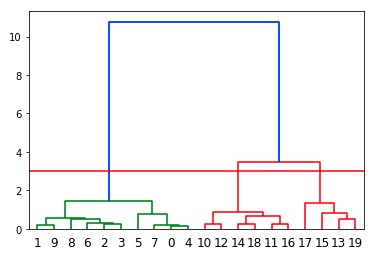
the horizontal cut will produce k=3 clusters. Now you need to follow descendants of these three nodes and assign them labels of their parent.
Once you are done with "by cluster number" you can easily implement method "by threshold" using this logic
| // 3. Compute dendrogram | ||
| // | ||
| // The linkage distance threshold above which clusters will not be merged. | ||
| fn fit(data: &M) -> Result<AggregativeFastPair<T, M>, Failed> { |
There was a problem hiding this comment.
Do you plan to add different types of linkage (“ward”, “complete”, “average”, “single”) later? Even if you plan to support only "ward" at this moment we still should have an enum parameter linkage with a single item "ward"
There was a problem hiding this comment.
FastPair works only and only with single. To add different linkages we need also to add an alternative algorithm like NearestNeighbour that can work with all the linkages.
PS. on another side: what about using different distances functions to compute the pairwise distances?
There was a problem hiding this comment.
I feel that it should be possible. Take a look at this paper:
"We can perform median, centroid, Ward’s, or other
bottom-up clustering methods in which clusters are represented by objects, in time
O(n^2 log^2n) and space O(n)."
There was a problem hiding this comment.
I don't know if I understood wrong but I think that paper refers to fastcluster that is the clustering algorithm; FastPair is a closest neighbour algorithm. The correspective of FastPair in that paper is the Nearest Neighbour algorithm that can be used with other linkages. FastPair instead can be used only with single as, if I remember correctly, stated in the FastPair paper.

Add some basic tests
…issue-11-agglomerative-clustering
…issue-11-agglomerative-clustering
|
moved on with #142 |
2 participants


This is a draft PR to collect feedback on the preliminary research phase about implementing Agglomerative clustering via Muellner's "Modern hierarchical, agglomerative clustering algorithms", 2011.
The paper is interesting as presents an historical perspective for sequential, agglomerative, hierarchic, nonoverlapping methods (SAHN). As you may read in the documentation string in the module, different algorithms are presented in different versions; they are compared to what is called
PRIMITIVE_CLUSTERINGand formally proofed.As the objective is to have
MST-linkage(fastcluster) implemented, we need to go through some preliminary work with older algorithms as the objective implementation requires multiple procedures and data structures to be implemented:LABEL(akaunion-find), as in Fig.5 in Müllner, 2011These can be more easily implemented using Rust compared to C++; the latter requires custom implementations (see
class doubly_linked_listandclass auto_array_ptrthat provide safer wrapper over C++ std library, those should be implemented in a more straightforward way using Rust stdlib); any suggestion or insight about how to proceed with these implementations are welcome.There is a native-C++ implementation here that may provide a shortcut compared to the original Muellner code for fastcluster that implies R/Python bindings.
As a roadmap, I would suggest to start implementing
PRIMITIVE_CLUSTERINGas knowledge-building to tackle fastcluster that requires quite a lot of reasoning over the mentioned procedures of post-processing and data structures: (1.) is not quite clear to me yet and for (2.) we need to find the right Rust implementation to do it (I considered usingpetgraphas it looks like the standard way to handling graph-like structures). Once we have these latest things, we can move on to implementMST-linkage.Please correct anything wrong found in the above construct.